
Percale vs sateen sheets: weave, feel and care

Compare crisp percale with smoother sateen without treating either as a cooling guarantee.
Last updated October 2026
Contents10
- Percale vs sateen sheets at a glance
- How percale's construction affects the face
- How sateen differs
- Choose for texture before chasing a number
- Keep warmth claims in context
- Check care for the actual range
- Dimensions don't follow the construction name
- More in this guide
- Frequently asked questions
- Verdict on percale vs sateen sheets
Percale vs sateen sheets is a choice between fabric constructions, not between cotton and a separate fiber called sateen. Percale has a plain crossing pattern and a crisp feel. Sateen has longer yarn runs across its face, giving a smoother surface with more sheen.
Choose percale if you prefer a crisp, matte fabric. Choose sateen if you prefer a smoother face and a slight shine. Check the actual fiber label for both. Construction doesn't settle warmth or wear on its own. Compare the sheet's weight and finish, then its dimensions and wash rules. Neither name guarantees cooling or better sleep.
Percale vs sateen sheets at a glance
| Check | Percale | Sateen |
|---|---|---|
| Yarn pattern | Plain over-and-under crossing | Longer runs across the face |
| Typical surface | Matte | More sheen |
| Starting feel | Crisp | Smooth |
| Fiber | Check the label; often cotton | Check the label; often cotton |
| Care | Follow the exact item | Follow the exact item |
| Best use of the label | Narrow your texture choice | Narrow your texture choice |
Scroll for more →
Those are fabric descriptions, not our test scores. We compare published construction details. We haven't measured a cooling difference or ranked the life of these two fabrics in a home trial.
How percale's construction affects the face
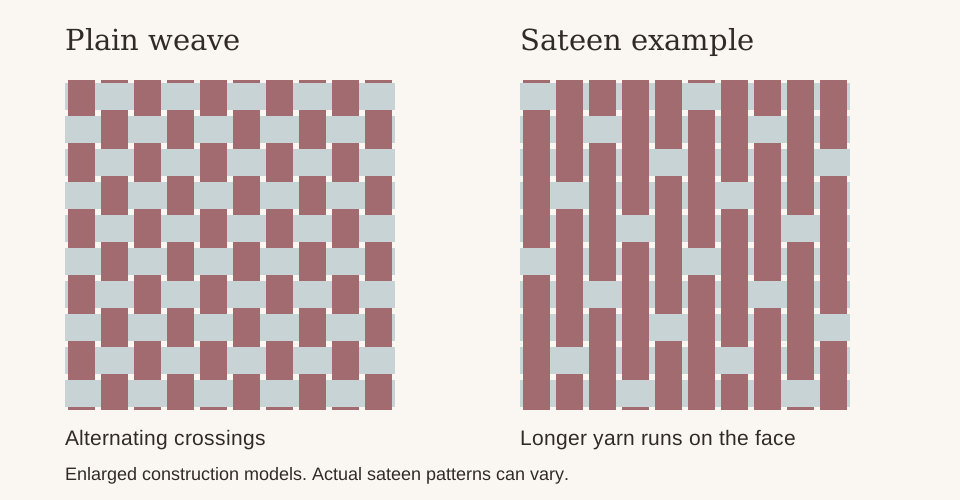
In a plain pattern, each yarn alternates over and under the yarns crossing it. That gives a different face from a fabric with longer exposed yarn runs. Cotton percale is commonly described as crisp and matte.
The name doesn't tell you every part of the feel. Yarn thickness and finishing can make two percale sheets different. Don't assume that everything using the term has the same fabric weight or softness.
Read the full composition. Percale is a construction term, so it doesn't replace the fiber label. If the exact blend isn't clear, ask for it before buying. Our percale explanation covers the label in more detail.
How sateen differs
Sateen places longer yarn runs on the face. That gives a smoother surface and more sheen. The exact crossing pattern can vary, so don't treat a single maker's recipe as the only possible sateen.
A cotton sateen sheet is still cotton. It doesn't become silk because it has a lustrous face. Read the fiber label when a seller uses silky as a feel description rather than a material claim.
Longer exposed yarn runs are also a reason to handle the fabric with care around rough objects. Follow the maker's laundry advice and keep it away from items that can catch on the surface. Don't turn this into a fixed lifespan prediction.
Choose for texture before chasing a number
Think about the surface you want against your skin. A crisp shirt is a useful comparison for percale's character. A smoother cotton face with some shine points toward sateen. Your preference can matter more than which count is larger.
Thread count isn't a direct scale from rough to soft. It doesn't include every part of yarn quality or finishing. The thread-count guide explains why a single number can't choose between the two.
If possible, handle a sample. Check the return terms if you can't. Don't assume a fabric you dislike on arrival will necessarily become your preferred feel after repeated washing.
Keep warmth claims in context
Makers often describe percale as a lighter or crisper choice and sateen as smoother or more draping. Those descriptions can guide a shortlist, but they don't prove what temperature you'll feel in a complete bed.
The mattress protector and filled top layer also matter. A thin sheet can't cancel out a heavy comforter. Compare the whole setup rather than blaming or crediting one fabric name for the result.
If a seller gives a measured cooling claim, read its test conditions. Check what was compared and whether it applies to the exact item. Where those facts are absent, don't treat the claim as a known performance result.
Check care for the actual range
Read the wash temperature and cycle on each sheet. Check allowed bleach, drying heat and ironing instructions. Two cotton ranges can have different finishes and different care rules. Follow the item in your hand.
If your goal is a smooth bed, remove sheets promptly when the care cycle finishes. Straighten them before folding or fitting. Don't use a hot iron on a finish that prohibits it, and don't leave a damp sheet in storage.
Choose a fabric whose normal appearance you can accept. A softly creased percale may suit your bed without ironing. A smooth face is a preference, not a sign that a sheet is cleaner or of a higher grade.
Dimensions don't follow the construction name
Measure the mattress footprint. Then check its full height through any topper. Compare that total with the fitted sheet's pocket limit. Percale and sateen labels don't tell you the dimensions.
Check the flat sheet and pillowcase sizes too. A pack can use a combined full/queen label or include a case length that doesn't match your pillows. Use our sheet size guide before selecting the size variant.
More in this guide
Frequently asked questions
Is sateen the same as satin?
No. They are related construction terms, but they aren't interchangeable product specifications. A shiny surface doesn't identify the fiber. Read the full label to know whether a sheet contains cotton, silk or a manufactured fiber. Don't buy from the word silky alone if material content matters to you.
Is percale always cotton?
The construction name doesn't establish the fiber by itself. Cotton percale explicitly names both, while a shorter listing may leave composition unclear. Check the sewn-in label or the full product details. If a blend is used, read each percentage rather than assuming the fabric is pure cotton.
Can both fabrics wrinkle?
Yes. The construction name doesn't promise a wrinkle-free result. The fiber, finish and care process all matter. Read any easy-care claim alongside its instructions. Choose a normal fabric appearance you like, and use only the drying or ironing settings that the exact sheet allows.
Which one lasts longer?
There is no fixed answer for all products from the names alone. Yarn and finishing differ, and care affects wear. Compare the exact specification and terms rather than assigning a lifespan to every percale or sateen sheet. We don't claim a wear test of either fabric here.
Verdict on percale vs sateen sheets
Percale vs sateen sheets is mainly a texture decision after fit and care are clear. Choose the face you prefer, and compare actual specifications. Our sheet material guide and bedding homepage can help with the remaining checks.
The weave distinctions follow the CottonWorks home textile guide and Brooklinen's fabric descriptions. These sources explain the construction; they are not our hands-on verdicts.
The bedding glossary explains ply, thread count and other terms used alongside weave names.