
Sleep duration and restfulness: a joint NHIS analysis
Read a weighted joint analysis of 2024 NHIS answers about hours of sleep and feeling rested.
Last updated October 2026
Contents7
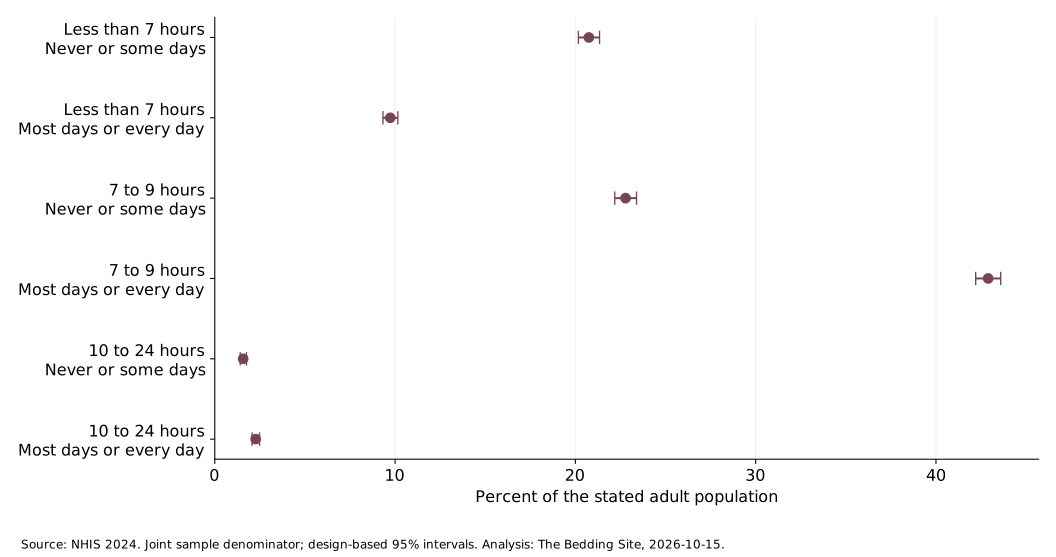
Some adults reported seven to nine hours of usual sleep. They also said they woke well-rested never or on some days. This joint group accounts for 22.8% of adults with valid answers in the 2024 NHIS file. Its 95% interval is 22.2% to 23.4%.
That share uses the full valid joint sample. It is not a percentage only of seven-to-nine-hour sleepers.
The research question
Do reported hours and feeling rested tell the same story on the same adult records? Separate published percentages can't establish their overlap. We used the two variables together on each public-use record, then applied the adult survey weights and design.
The result is an association between two self-reports. It isn't evidence that bedding causes restfulness, and it doesn't identify a medical condition.
Duration and restfulness definitions
SLPHOURS_A asks about average sleep in a 24-hour period, recorded as whole hours using the questionnaire's rounding instructions. We grouped valid answers into less than seven, seven to nine and ten to 24 hours. The middle group is a descriptive band, not an individual sleep prescription.
SLPREST_A asks how often the adult woke well-rested during the past 30 days. We grouped never with some days, and most days with every day. The questions have different time frames. Neither is a wearable-device measurement.
Joint distribution and uncertainty
The complete table above contains all six joint cells. Each percentage uses all adults with valid responses to both questions as its denominator. It does not use only the row's duration group. The rounded cells may not add to exactly 100%.
There are 31,463 valid joint records from 32,629 sample-adult records. We exclude 1,166 with a missing or invalid answer to either question. Those exclusions aren't recoded as short sleep or as feeling unrested.
Checks against published figures
Before calculating joint cells, we reproduced two Data Brief 559 national figures using each question's own valid-response denominator. Our short-sleep estimate is 30.476%, which rounds to the published 30.5%. Our well-rested estimate is 54.835%, which rounds to the published 54.8%.
Those checks use all valid records for each separate question. The joint table requires both answers, so its combined margins need not be identical. We don't force them to match by changing weights or filling missing answers.
How the analysis was produced
We used the public adult CSV for 2024. We checked its fields against the codebook dated June 18, 2025 and the survey guide. The design fields are:
- WTFA_A: The final adult weight, used to give each record its proper share in the total.
- PSTRAT: The public-use stratum, a group in the sample design.
- PPSU: The public-use sampling unit within that group.
For each cell, we divide its weighted total by the weighted total for all valid joint records. We use Taylor linearization to work out sampling error. This adds the spread in residual totals across sampling units within each stratum. The methods download gives the full formula. Records outside the valid group stay in the design, with no contribution to that group's total.
The design contains 52 strata and 662 sampling units, giving 610 design degrees of freedom. We use a Student t multiplier and a logit transformation for the 95% intervals. These are design-based sampling intervals; they don't include every possible reporting or nonresponse error.
All six cells have at least 508 observed records. None is hidden as a small-cell estimate in this broad grouping. More detailed age or demographic splits would need a new reliability assessment; they aren't part of this report.
Limits and interpretation
Usual hours and recent restfulness are self-reports with rounding and recall limits. A cross-sectional association cannot establish which factor came first or what caused it. The study does not measure bedding materials or test any product.
Don't read seven to nine hours as proof of adequate sleep for every person. Likewise, feeling rested on some days is not a diagnosis. Use the variables for the definitions they actually measure.
Downloads, dates and corrections
Download the aggregate joint CSV, methods or interval chart. Survey year: 2024. Analysis date: October 15, 2026. Next source review: January 15, 2027. The download contains no respondent identifiers.
Report a correction through contact, naming the cell or calculation. We revise the data, chart and method together. This is analysis version one, with no earlier correction history claimed.
Sources: NHIS 2024 release and documentation, public codebook, survey design, Data Brief 559. Public US government data are reused with attribution; no agency endorsement is implied. Return to sleep research or compare county short-sleep estimates.