
Adults with household children: 2025 sleep diaries
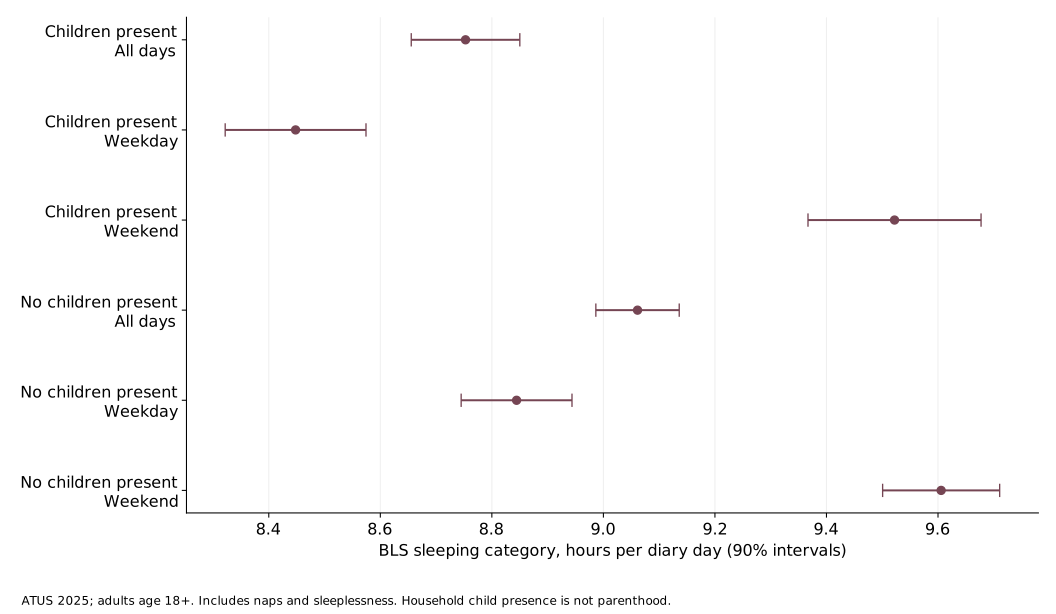
Compare 2025 BLS diary time by household child presence and day type, with sample counts and survey error.
Last updated October 2026
Contents8
Adults with children in their household recorded less time in the BLS sleeping category on weekdays than on weekends. Their weighted means were 8.45 and 9.52 hours per diary day. The standard errors were 0.0767 and 0.0943 hours. The table shows all six group estimates and their sampling error.
These are averages for groups of adults, not changes tracked in the same people. The BLS sleeping definition includes sleeplessness as well as naps. It does not measure hours of sound sleep.
The research question
How does diary time in the sleeping category differ by household child presence and day type? We used the 2025 American Time Use Survey (ATUS). Each person described one day, so this is a view of time use across groups.
The report concerns adults who live with children. It does not identify parents. An adult may live with a child who is a sibling or another relative. A parent whose children live elsewhere may be in the group without household children.
Group definitions and diary days
We include adults age 18 and over. The source field TRHHCHILD records whether the household has a child under 18: one means yes and two means no. We use that field as child presence only. We make no split by the child's age and no claim about care duties.
The diary-day field TUDIARYDAY runs from Sunday, code one, to Saturday, code seven. Weekdays are Monday to Friday, codes two through six. Weekends are Saturday and Sunday. A holiday keeps its calendar day in this report. Our weekend group therefore differs from BLS tables that combine weekends and holidays.
Each person stays in the table's stated group even if their diary has no sleeping time. Each day-type row uses only that group's days as its denominator. The all-days estimate uses the survey weights across all days; it is not a simple average of the weekday and weekend means.
What the weighted comparisons show
Adults without household children averaged 8.84 hours on weekdays (SE 0.0604 hours) and 9.61 hours on weekends (SE 0.0638 hours). Both household groups had higher point estimates on weekends. The rows describe time use, without explaining why the means differ.
The all-days means are 8.75 hours for adults with household children and 9.06 hours for adults without them. The groups differ in age and may also differ in work or health. We have not adjusted for those traits. We do not treat the gap as an effect of children or as a test of any bedding product.
Check against the published national figure
Before splitting adults into groups, we reproduced the BLS Table 1 benchmark for everyone age 15 and over. Our result is 9.032736673 hours per day, with SE 0.036103593 hours. It rounds to 9.03 hours, matching the published 2025 figure of 9.03. That check passes at the table's displayed precision.
The benchmark includes ages 15 to 17; the adult table does not. Of 6,146 source respondents, 6,028 are adults and 118 are under 18. No adult has a missing age, household-child code or diary-day code. We do not force the adult means to equal the broader national mean.
How the analysis was produced
The official source files were downloaded from bls.gov in a browser on October 16, 2026. We used the 2025 respondent and roster files, plus the activity file and the replicate-weight file. The roster gives the respondent's age. We joined by the case ID and, for age, the person's roster line. We checked unique keys and complete matches across all four files.
We sum all diary minutes in BLS activity tier 0101. Its detailed codes are 010101 for sleeping, 010102 for sleeplessness and 010199 for sleeping not elsewhere classified. This follows the published BLS sleeping category. Naps count, and time coded as sleeplessness counts. We checked that every complete diary totals 1,440 minutes across all activities.
The annual final weight is TUFINLWGT. TUFNWGTP is a multi-year weight, which we do not use. For each group, we sum weight times sleeping minutes and divide by the group's total weight. We then divide minutes by 60 to get hours. Zero-sleep diaries stay in the denominator.
We repeat that ratio with each of the 160 official replicate weights. Variance equals 4/160 times the sum of squared gaps between each replicate mean and the full mean. The square root gives the SE. The methods download states the formula and field names in full.
The intervals use the mean plus or minus 1.645 SE. This gives an approximate 90% sampling interval, following the BLS technical note. It describes how much a group estimate may vary with the sample. It is not a range of sleep hours for individual adults.
Reliability and small cells
The guide's Appendix N requires attention to sample size, the count doing an activity and its SE or relative error. It directs users to BLS staff for the detailed cutoffs. We cannot claim to have applied those unpublished rules in full.
Our own screen hides a mean if the group or its count with nonzero sleeping time is below 100. It flags a relative SE above 10%. Relative SE means SE divided by the mean, times 100. These are site screening rules, not official BLS cutoffs.
All six cells pass this screen. The smallest has 773 diaries; relative SEs are below 1%. The CSV also gives counts with nonzero sleeping time and the relative SE for each cell. Passing the screen does not remove sampling error or certify compliance with BLS's full rules.
Sampling and diary limits
One recalled diary day cannot measure a person's usual sleep, sleep quality or sleep need. The category includes time awake that is coded as sleeplessness. It is not a diagnosis of insomnia. Recall, coding and nonresponse can affect results beyond the sampling error shown here.
Weekday and weekend rows use different people. The figures do not show that the same adult gained sleep at the weekend. We do not run formal tests of the gaps or claim a causal effect. Household child presence also leaves many family details unknown.
This time-use measure differs from the usual hours and recent restfulness questions in our NHIS report. Do not combine the two surveys as if their units and questions were the same. Neither report tests products or gives personal sleep advice.
Downloads, dates and corrections
Download the aggregate CSV, methods, source-file hashes or interval chart. The downloads contain group estimates and file details, with no individual records. Survey year: 2025. Source download and analysis date: October 16, 2026. Next source review: January 15, 2027.
This is version one of the report. To report an error, use contact and name the group and diary-day row. We update the table, chart and methods together if a correction changes a result.
Sources: 2025 ATUS files, 2025 interview dictionary, ATUS user's guide, published Table 1 and technical note. Public US government data are reused with attribution; no BLS endorsement is implied. Return to sleep research or compare county short-sleep estimates.