
Pillow size and case fit calculator
Enter pillow and case dimensions to compare sizes and spare space.

Contents9
Last updated October 2026
A standard pillow size is commonly 20 by 26 inches in US bedding charts. That is a useful starting label, not a guarantee for every pillow. Check the exact dimensions before pairing an insert with a case, especially with foam or shaped pillows.
Use the pillow's actual width and length to choose a case. Common US charts list standard at 20 by 26 inches, queen at 20 by 30 and king at 20 by 36. Some named products differ. Check the case opening and whether its quoted size includes a border. Pillow length doesn't tell you the height or firmness under your head.
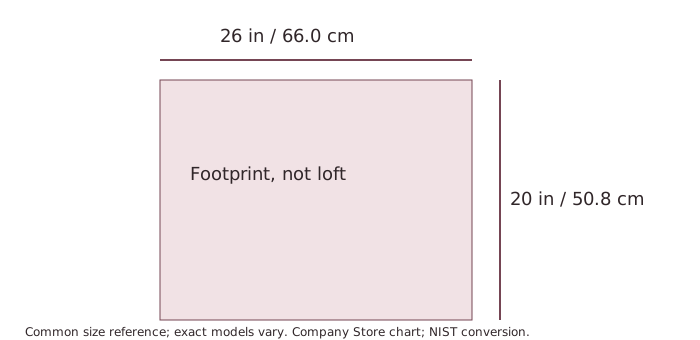
Standard pillow size and common US labels
The following chart follows The Company Store's current general pillow FAQ. It is a reference for those labels, not a specification for all makers. Centimeters use the exact inch conversion, rounded to one decimal place.
| Label | Width x length, inches | Width x length, cm |
|---|---|---|
| Standard | 20 x 26 | 50.8 x 66.0 |
| Queen | 20 x 30 | 50.8 x 76.2 |
| King | 20 x 36 | 50.8 x 91.4 |
| Euro | 26 x 26 | 66.0 x 66.0 |
Scroll for more →
The size reference uses The Company Store pillow FAQ and NIST's unit reference. An inch is exactly 2.54 cm. The table rounds each converted result while retaining the original inch measurement.
Check the product as well as the label
Casper's Pillows 101 uses the common 20-by-26-inch standard label in its general explanation, but lists different dimensions for some named pillows. This is why you need the exact model's chart before choosing a case.
A shaped foam pillow may have a height profile as well as width and length. A rectangular case can cover it, yet fit loosely or pull at its highest point. Check the maker's cover instructions and avoid forcing the core through a small opening.
If the seller gives only a size name, ask for measurements. Don't fill the gap with a generic chart. You can't know the fit tolerance from the word standard alone.
Measure an existing pillow
Lay it flat without pulling the shell tight. Measure across the seams in both directions. Record width and length separately from any stated loft. If the shell has a gusset, record that feature too.
For a used pillow, measure it in its current clean, dry state. Don't add a guessed shrinkage allowance. If you are matching a new insert to a decorative sham, use the sham maker's intended insert dimensions.
Check a removable cover separately. Its outer edge may not be the same as the usable insert space, especially if there is a decorative flange. A pack's photograph can't resolve that difference.
Pair pillows and cases
An overlong case can leave loose fabric beyond the pillow. A short case can squeeze the fill or leave the opening stretched. An envelope closure needs enough room for the inner flap to wrap around the insert.
Check both the case's listed size and the maker's fit advice. Don't assume the dimensions printed for a finished case should equal those of a pillow seam for seam. The case may include an allowance for the filling and closure.
A protector adds another layer. Fit it first, then the case. If the combination pulls the pillow into a hard lump, check whether either covering is too tight. Don't assume that a firm feel comes from the filling alone.
Work out space on the bed
Add the lengths of the pillows you want side by side, then compare that with the mattress width. Two 26-inch-long pillows span 52 inches when placed flat end to end. Two 36-inch pillows span 72 inches. Those are simple layout sums, not a rule for how many pillows a bed needs.
Allow for how you use the bed. Pillows may overlap or sit at an angle. A headboard or narrow alcove can limit the arrangement even when the mattress width looks sufficient on paper.
Use a tape or your existing pillows to check the layout before buying. Keep loose decorative pieces separate from the pillows you sleep on. A styled photo can show an arrangement that leaves little room for normal use.
Size doesn't choose the sleeping feel
Standard, queen and king usually describe the footprint. They don't tell you how much the pillow compresses under your head. Two pillows of equal length can have very different filling and height.
Choose the dimensions for bed and case fit. Then compare the model's construction and your own comfort in your usual position. Don't treat a size chart as proof of pain relief or better sleep.
More in this guide
Frequently asked questions
Is queen always longer than standard?
In the common chart above, queen adds four inches of length. But check the exact product range rather than assuming every seller uses that chart. Some brands use combined standard/queen labels. Compare measurements before ordering matching cases, particularly if you already own a fitted protector.
Does a king bed need king pillows?
No. You can choose the layout and pillow length that work for you. Compare the total width of your arrangement with the mattress and headboard. A king label on the bed doesn't require the same label on every pillow or case. Fit the pillowcase to the pillow itself.
Are Euro pillows bed pillows?
Euro names a square format in the chart above. It doesn't by itself say what the filling is or how you should use it. Many square shams serve a decorative purpose. Check the intended use and care of the exact insert rather than treating the square size as a sleeping recommendation.
Verdict on standard pillow size
Standard pillow size is a helpful search label, but the model's measurements decide the fit. Measure the pillow and check the case before buying. Use guest-room bedding to plan a spare set, or return to bedding fit guides.
The bedding glossary explains sham, flange and gusset when those terms appear in a size chart.